<?xml version="1.0" encoding="utf-8"?><feed xmlns="http://www.w3.org/2005/Atom" ><generator uri="https://jekyllrb.com/" version="4.4.1">Jekyll</generator><link href="https://leonardchau.com/feed.xml" rel="self" type="application/atom+xml" /><link href="https://leonardchau.com/" rel="alternate" type="text/html" /><updated>2026-07-04T12:53:05-07:00</updated><id>https://leonardchau.com/feed.xml</id><title type="html">Leonard Chau</title><subtitle>Mechanical Engineer, Maker &amp; Researcher — SF Bay Area</subtitle><author><name>Leonard Chau</name><email>leonard.chau@yahoo.com</email></author><entry><title type="html">Stability COMmander</title><link href="https://leonardchau.com/blog/2026/stability-commander/" rel="alternate" type="text/html" title="Stability COMmander" /><published>2026-05-08T12:00:00-07:00</published><updated>2026-05-08T12:00:00-07:00</updated><id>https://leonardchau.com/blog/2026/stability-commander</id><content type="html" xml:base="https://leonardchau.com/blog/2026/stability-commander/"><![CDATA[<p><strong>Stability COMmander</strong> is a real-time telehandler stability control project designed to prevent tip-over by tracking the vehicle–load center of mass and evaluating it against the machine’s support polygon. The system combines embedded control logic, dynamic simulation, and a physical prototype to validate stability behavior under realistic mechanical constraints.</p>

<h2 id="my-contribution">My contribution</h2>

<p>My largest contribution was the <strong>hardware</strong> side of the project. I was responsible for hardware selection, 3D CAD design, fabrication, and geometry validation of the physical prototype.</p>

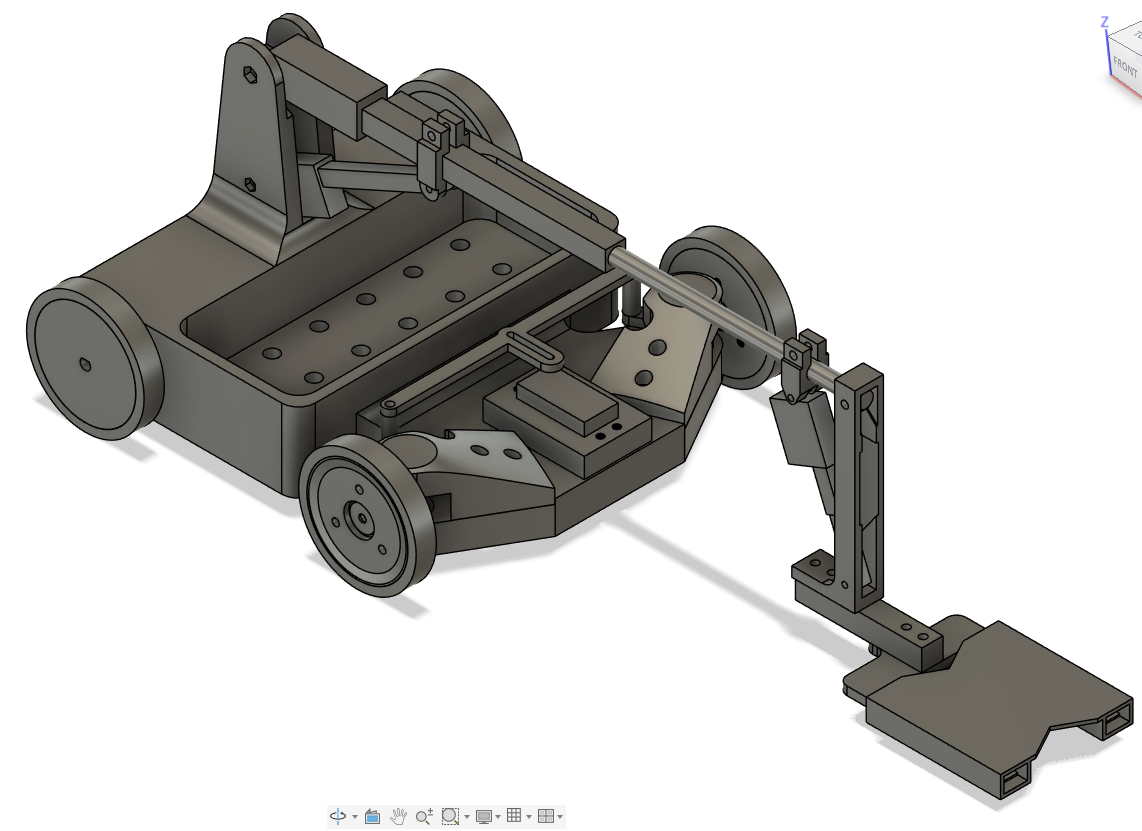
<p>I selected components based on operating voltage, required torque, actuator motion requirements, and overall project budget. I also designed the boom and mounting geometry in CAD so the actuators could achieve the desired range of motion while accurately representing telehandler behavior.</p>

<p>The physical prototype mattered because it turned the project from a purely digital simulation into a system that could be tested against real hardware constraints.</p>

<h2 id="key-responsibilities">Key responsibilities</h2>

<ul>
  <li>Selected motors, actuators, drivers, and mechanical components based on voltage, torque, cost, and system requirements</li>
  <li>Designed the boom structure and actuator mounting points in 3D CAD</li>
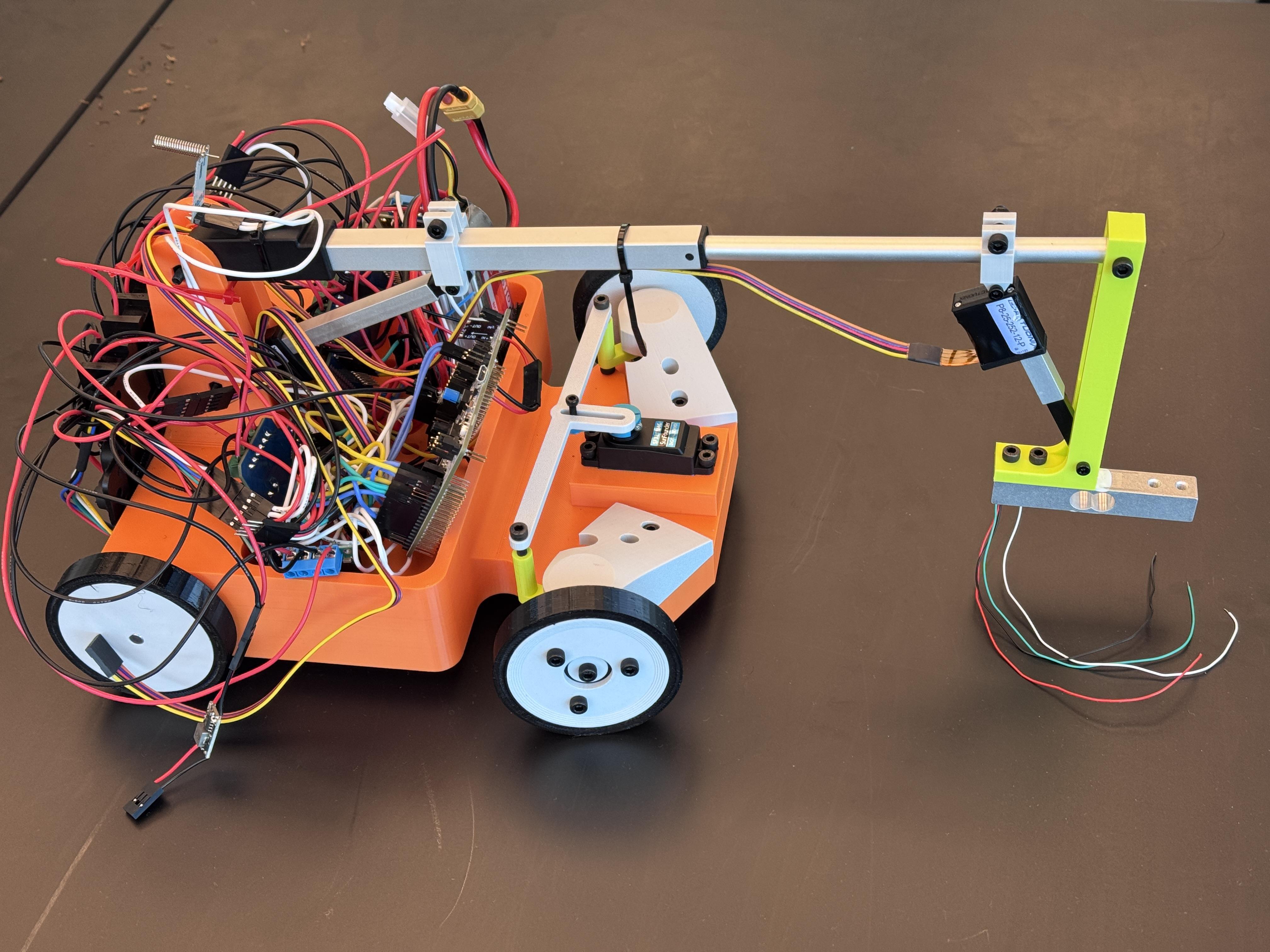
  <li>Fabricated and assembled the physical prototype</li>
  <li>Validated boom geometry to confirm the actuators could reach the desired range of motion</li>
  <li>Supported integration between the physical prototype, embedded control logic, and simulation model</li>
  <li>Identified mechanical limitations that affected system stability and actuator performance</li>
</ul>

<h2 id="technical-highlights">Technical highlights</h2>

<ul>
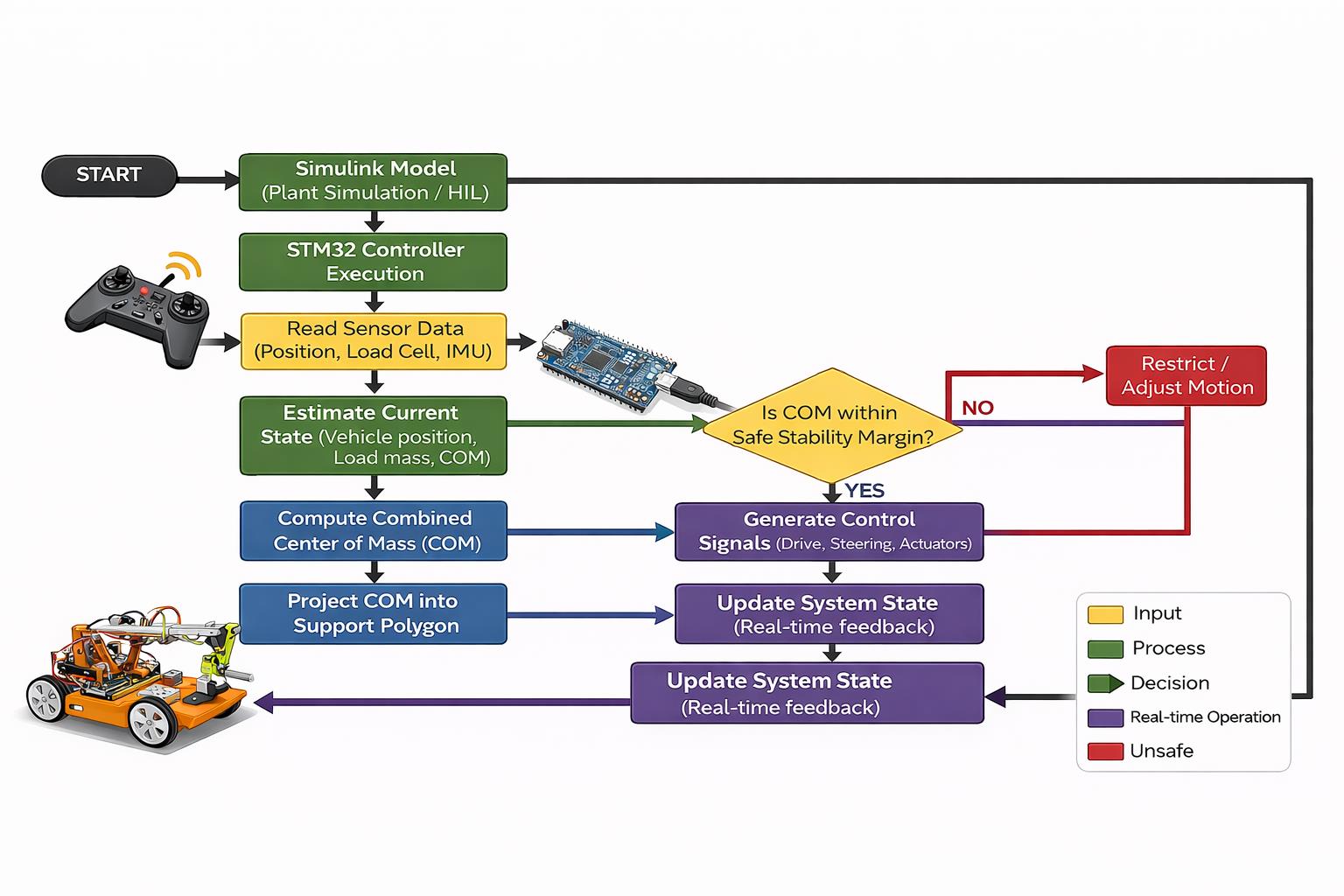
  <li>STM32-based embedded control system</li>
  <li>Hardware-in-the-loop validation with MATLAB/Simulink</li>
  <li>Real-time center of mass calculation</li>
  <li>Support polygon stability evaluation</li>
  <li>1 cm stability margin for safety enforcement</li>
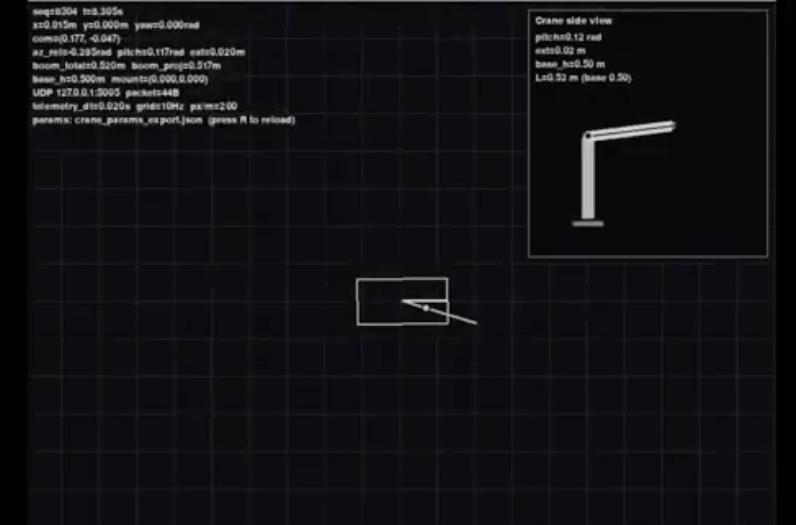
  <li>Python/Pygame visualization of vehicle motion, boom position, COM location, and stability boundaries</li>
  <li>Physical prototype used to validate geometry and system assumptions</li>
</ul>

<h2 id="engineering-challenge">Engineering challenge</h2>

<p>One of the hardest parts of the project was getting the <strong>boom geometry</strong> right. Actuator stroke length, mounting position, and linkage geometry all had to work together so the boom could achieve the full desired range of motion.</p>

<p>Small changes in actuator placement significantly affected how the boom moved, so I iterated on the CAD design until the mechanism could extend and rotate properly without hitting mechanical limits.</p>

<h2 id="design-issue-and-lesson-learned">Design issue and lesson learned</h2>

<p>During testing, we discovered that the selected actuators were <strong>backdriveable</strong>. The load required to approach a tipping condition exceeded the actuators’ static holding capability, so the boom could move when it was supposed to remain fixed.</p>

<p>Addressing this would have required <strong>active position maintenance</strong> (for example closed-loop actuator control), which we could not fully implement within the project timeline.</p>

<p>This was an important lesson: for stability-critical mechanical systems, <strong>actuator holding force and backdrivability</strong> matter as much as motion capability.</p>

<h2 id="star-experience">STAR experience</h2>

<p><strong>Situation</strong><br />
Our team was developing a stability control system for a telehandler, but simulation alone would not fully capture real-world mechanical constraints.</p>

<p><strong>Task</strong><br />
My task was to design and build a physical prototype that accurately represented the boom geometry and allowed the stability control concept to be validated beyond a purely theoretical model.</p>

<p><strong>Action</strong><br />
I selected hardware based on voltage, torque, actuator motion, cost, and system compatibility. I designed the boom and actuator mounting geometry in CAD, fabricated the assembly, and validated that the actuators achieved the intended range of motion. When we found the actuators were backdriveable under higher loads, I helped identify the cause and concluded that active position maintenance would be needed for future work.</p>

<p><strong>Result</strong><br />
The prototype moved the project beyond digital simulation and gave the team a physical platform for validating geometry, actuation limits, and stability assumptions. The hardware work made the control system more realistic and highlighted practical challenges in safety-critical control on real equipment.</p>

<h2 id="impact">Impact</h2>

<p>Without the physical prototype, the project would have stayed a theoretical simulation. The hardware made it possible to evaluate real-world constraints such as actuator placement, boom range of motion, fabrication tolerances, and load-holding limitations.</p>

<p>The project strengthened my experience in mechanical design, hardware selection, CAD modeling, fabrication, embedded systems integration, and engineering tradeoff analysis.</p>

<h2 id="skills">Skills</h2>

<ul>
  <li>3D CAD design</li>
  <li>Hardware selection</li>
  <li>Mechanical fabrication</li>
  <li>Geometry validation</li>
  <li>Actuator sizing</li>
  <li>Embedded systems</li>
  <li>MATLAB/Simulink</li>
  <li>STM32</li>
  <li>Python visualization</li>
  <li>System integration</li>
  <li>Engineering tradeoff analysis</li>
</ul>

<h2 id="media">Media</h2>

<h3 id="cad-assembly">CAD assembly</h3>

<figure class=""><img src="/assets/img/2026/stability-commander/cad-assembly.png" alt="Full CAD assembly of the Stability COMmander telehandler prototype" /><figcaption>
      Full CAD assembly used to validate actuator stroke, mounting geometry, and boom range of motion prior to fabrication.

    </figcaption></figure>

<h3 id="physical-prototype">Physical prototype</h3>

<figure class=""><img src="/assets/img/2026/stability-commander/physical-prototype.jpeg" alt="Fabricated physical prototype boom and actuator hardware" /><figcaption>
      Fabricated prototype used to check real linkage motion, actuator placement, and load-holding behavior against the CAD intent.

    </figcaption></figure>

<h3 id="hardware-architecture">Hardware architecture</h3>

<figure class=""><img src="/assets/img/2026/stability-commander/hardware-signals-flowchart.jpeg" alt="Flowchart of onboard hardware architecture and signal paths" /><figcaption>
      Hardware and signal flow between sensors, MCU, actuator drivers, and power paths.

    </figcaption></figure>

<h3 id="visualization">Visualization</h3>

<figure class=""><img src="/assets/img/2026/stability-commander/pygame-visualization.jpeg" alt="Pygame visualization of chassis motion, boom, and stability bounds" /><figcaption>
      Interactive visualization tying vehicle kinematics and stability diagnostics to operators and debug scenarios.

    </figcaption></figure>

<h2 id="links">Links</h2>

<ul>
  <li><strong>GitHub:</strong> <em>[repository URL — add when ready]</em></li>
  <li><strong>Demo video:</strong> <em>[link — add when ready]</em></li>
  <li><strong>Portfolio / resume:</strong> <em>[optional link — add when ready]</em></li>
</ul>

<hr />

<p><em>Capstone project — hardware focus: boom prototype, integration, and mechanical validation.</em></p>]]></content><author><name>Leonard Chau</name><email>leonard.chau@yahoo.com</email></author><category term="School" /><category term="Projects" /><category term="school-project" /><category term="capstone" /><category term="mechanical-engineering" /><category term="embedded-systems" /><category term="control-systems" /><category term="cad" /><category term="fabrication" /><category term="stm32" /><category term="matlab" /><category term="simulink" /><category term="python" /><category term="hardware-in-the-loop" /><category term="simulation" /><summary type="html"><![CDATA[Real-time telehandler stability control prototype tracking vehicle–load center of mass against the support polygon — STM32 embedded logic, MATLAB/Simulink HIL, Pygame visualization, and a fabricated boom prototype.]]></summary></entry><entry><title type="html">MingKwai, Rediscovered - A Symposium on the Revolutionary Chinese Typewriter</title><link href="https://leonardchau.com/typewriters/history/events/mingkwai-rediscovered-symposium/" rel="alternate" type="text/html" title="MingKwai, Rediscovered - A Symposium on the Revolutionary Chinese Typewriter" /><published>2025-12-02T07:00:00-08:00</published><updated>2025-12-02T07:00:00-08:00</updated><id>https://leonardchau.com/typewriters/history/events/mingkwai-rediscovered-symposium</id><content type="html" xml:base="https://leonardchau.com/typewriters/history/events/mingkwai-rediscovered-symposium/"><![CDATA[<figure class=""><img src="/assets/img/mingkwai-symposium.jpg" alt="MingKwai Chinese Typewriter Symposium at Stanford University" /><figcaption>
      

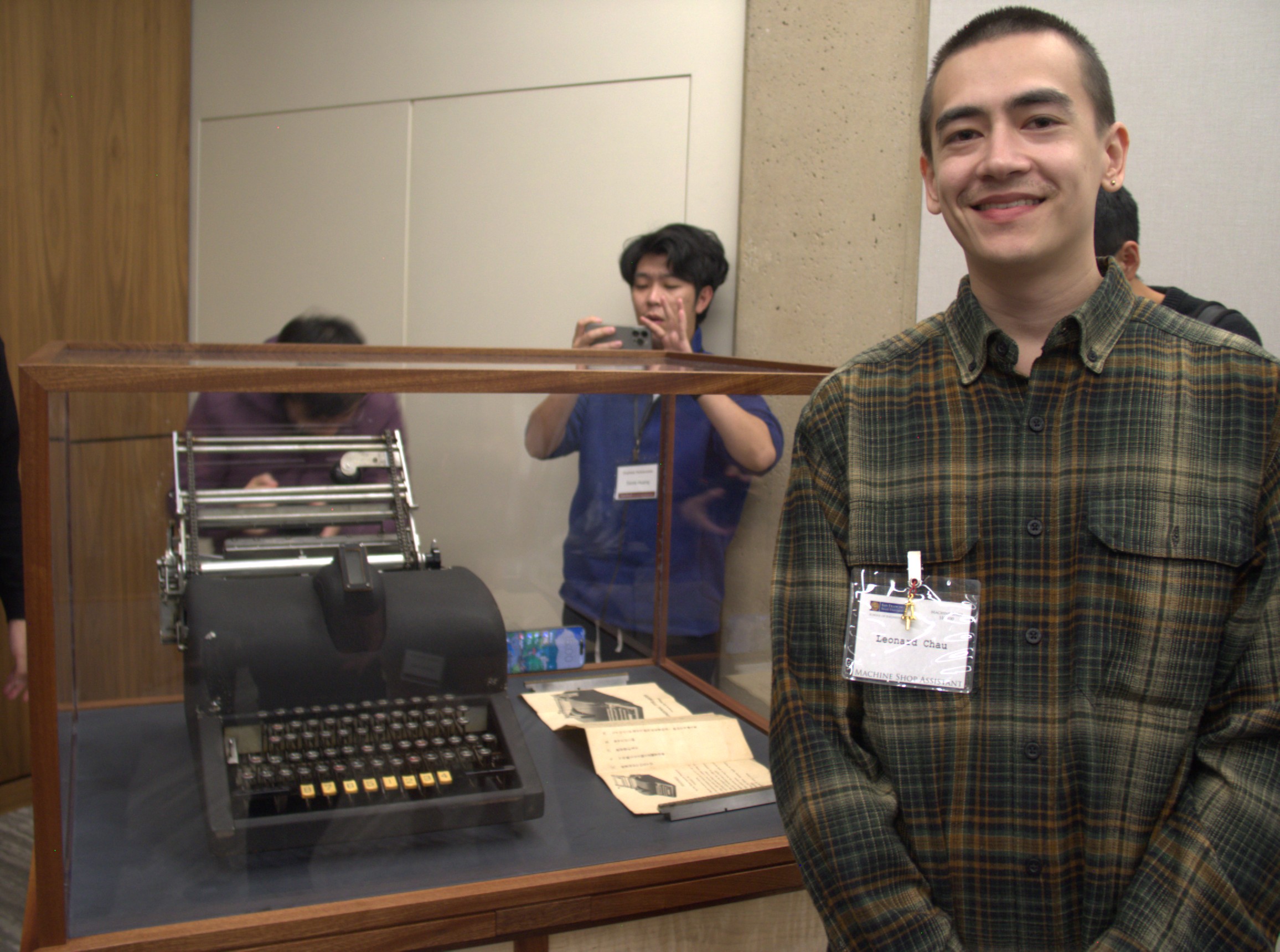
    </figcaption></figure>

<p>On December 2, 2025, I had the privilege of attending “MingKwai, Rediscovered” at Stanford University—a symposium exploring the origins, history, and lasting impact of one of the most revolutionary (and perhaps underappreciated) inventions in the history of Chinese information technology: the MingKwai Chinese Typewriter.</p>

<h2 id="a-remarkable-discovery">A Remarkable Discovery</h2>

<p>The story begins with a discovery in a New York basement. The MingKwai Chinese Typewriter prototype, invented by Chinese-born author, translator, and cultural commentator Lin Yutang in the 1940s, was rediscovered in 2025 and entrusted to the Stanford University Libraries. This extraordinary machine, which represents a milestone in Chinese information technology, will now be used in research, exhibits, and academic programs at Stanford.</p>

<p>The symposium was organized to celebrate the typewriter’s rediscovery and new home at Stanford, bringing together scholars and experts from across multiple disciplines to reintroduce the legendary MingKwai to the world. Dr. Thomas S. Mullaney, Professor of Chinese History at Stanford University, led a team of researchers and students in exploring the MingKwai’s historical, technological, and cultural significance.</p>

<h2 id="meeting-the-felix-family">Meeting the Felix Family</h2>

<p>One of the highlights of the symposium was getting to speak with the Felix family, who made this remarkable discovery in their New York basement. Their story is a fascinating reminder of how history can be hiding in plain sight, waiting to be rediscovered.</p>

<p>They shared what it was like to find this strange machine—something they didn’t immediately recognize as historically significant—and the whirlwind that followed. After posting about their discovery on Facebook, they were completely unprepared for the response. Their post went viral in the typewriter and Chinese history communities, and suddenly they found themselves bombarded with messages.</p>

<p>Museums from around the world reached out. Chinese institutions expressed strong interest. Even governments contacted them, offering large sums of money for the typewriter. It must have been overwhelming—going from finding an unusual object in your basement to fielding serious inquiries from international institutions and governmental bodies, all offering significant financial incentives.</p>

<p>Thankfully, Dr. Thomas Mullaney graciously stepped in to guide them through this process. He helped them understand the historical significance of what they had found and navigate the complex world of artifact acquisition, ensuring that the MingKwai would find the right home—one where it would be properly cared for, studied, and made accessible for research and education.</p>

<p>Hearing their story firsthand added such a personal dimension to the symposium. This wasn’t just about a machine or an inventor—it was about a family who stumbled upon history and, with guidance from experts, made the decision to entrust it to an institution that would preserve and honor its legacy. Their journey from basement discovery to Stanford’s collection is a reminder that preserving history often depends on ordinary people making thoughtful decisions about remarkable objects.</p>

<p>When I inquired about the backstory of how the typewriter could have ended up in their family’s possession, they shared a fascinating connection: Mrs. Felix’s grandfather was affiliated with Linotype Company. This raises intriguing questions about the machine’s journey.</p>

<p>The Felix family connection to Linotype could mean several things. They might have been affiliated with the company after Lin was forced to sell the rights to the MingKwai prototype to Linotype in 1948, or they could have had a hand in the prototype’s creation or manufacture earlier. This opens up a compelling historical mystery.</p>

<p>Lin Yutang was, after all, not a mechanical engineer by any means. He was a writer, translator, and cultural commentator—someone who could conceive of revolutionary ideas for organizing and inputting Chinese characters, but who would have needed to outsource the actual mechanical engineering and manufacturing work. Yet nowhere in the documentation is there a name for who assisted with the prototype’s mechanical design and construction.</p>

<p>The possibility that someone at Linotype was assisting with the prototype or its manufacture—perhaps even before Lin had to sell the rights to the company—would explain both the quality of the mechanical work and how the machine ended up in a family with Linotype connections. It’s a tantalizing historical puzzle: who were the unnamed engineers who turned Lin’s brilliant conceptual framework into a working mechanical device?</p>

<p>This connection also adds another layer to understanding the circumstances surrounding Lin’s sale of the MingKwai rights to Linotype. If Linotype engineers were already involved in the prototype’s development, the sale might have been more than just a financial transaction—it could have been formalizing an existing relationship or bringing an in-progress project fully into the company’s portfolio at a time when Lin needed the funds.</p>

<h2 id="the-man-behind-the-machine">The Man Behind the Machine</h2>

<p>Lin Yutang was far more than just an inventor. In his early career, he was a writer, and his prototype of the MingKwai typewriter was completed in 1946. But his journey to creating this machine began with a fundamental problem: improving the phonebook/dictionary optimization for Chinese characters—the equivalent of creating an alphabetical order system for Chinese.</p>

<p>Lin was the first to create such a system, breaking Chinese characters into prefixes and suffixes in a revolutionary way. Before this innovation, there was no efficient method for organizing or retrieving Chinese characters. His system would become foundational to how Chinese text input works even today.</p>

<p>Lin was also the author of <em>My Country and My People</em>, a bestseller that remained on bestseller lists for 52 weeks and established him as one of the most influential interpreters of Chinese culture for the West in the first half of the 20th century. His book sales, in fact, likely funded the creation of the MingKwai machine—estimated at <strong><span>$</span>120,000</strong> at the time (worth approximately <strong><span>$</span>2 million</strong> today).</p>

<h2 id="how-the-mingkwai-works">How the MingKwai Works</h2>

<p>The MingKwai typewriter operates on a remarkably innovative system. It features:</p>

<ul>
  <li><strong>An upper bank of 36 keys</strong> - These select a type cylinder</li>
  <li><strong>A lower bank of 29 keys</strong> - These select an axial position on the type cylinder</li>
  <li><strong>8 selection keys</strong> - These rotate the type cylinder to a specified facet and print the selected character</li>
</ul>

<p>The upper and lower bank keys change what appears in the “Magic Eye”—a display showing up to 9 characters, with 8 available to print. If a 9th character is available, it goes to a “next page” option.</p>

<p>The system broke characters into prefixes and suffixes, and what makes this truly remarkable is that <strong>this is the first pop-up menu and the first input editor ever created</strong>—and the writing method is still fundamentally the same for Chinese input today. Modern users can reach speeds of 221 characters per minute in Chinese using systems derived from Lin’s innovations.</p>

<p>Perhaps even more significant is that the MingKwai is a <strong>visually designed</strong> typewriter—characters are typed based on how they are seen, not by their meaning or phonetic pronunciation. This revolutionary approach means that someone who didn’t know Chinese could theoretically write on this machine by visually picking out character components and piecing together words using three strokes (prefix, suffix, and selection). This visual approach democratized Chinese typewriting, making it accessible to users regardless of their linguistic knowledge, and represents a fundamentally different paradigm from phonetic or meaning-based input methods.</p>

<h2 id="the-physical-machine">The Physical Machine</h2>

<p>The MingKwai has 8 faces of 29 columns on 36 rods. The red keytops represent basic strokes, while the top 2 rows contain common radicals. Keytop symbols with a circle signify “other shapes,” while hollow shapes signify potential strokes.</p>

<p>The type used in the MingKwai was designed by Commercial Press, called Fanggu Huozi #2 (22pt) in traditional Chinese. The Latin alphabet was based on Memphis (Linotype).</p>

<p>Interestingly, the typewriter was designed primarily for vertical writing, but it supported multiple scripts and writing systems: Chinese, Latin, Japanese, Cyrillic, Bopomofo, Arabic numerals, Suzhou numerals, punctuation, symbols, and dingbats—with some vertical/horizontal options for Latin and other scripts.</p>

<p>The patent number for this invention is 2613795, and I was excited to learn that a digital recreation of the keyboard is currently in development.</p>

<h2 id="the-linotype-report-a-critical-examination">The Linotype Report: A Critical Examination</h2>

<p>One of the most fascinating aspects of the symposium was the discussion of Lin’s unfortunate situation in 1948, when he had to sell the rights to the MingKwai prototype to Linotype. The Felix family’s connection to Linotype adds an intriguing dimension to this story—could their relative’s involvement have been part of the pathway that led to Linotype’s acquisition?</p>

<p>The circumstances that forced Lin to sell his creation are a sobering reminder that financial pressures can shape the fate of even the most revolutionary inventions. Having invested an estimated <strong><span>$</span>120,000</strong> (worth approximately <strong><span>$</span>2 million</strong> today) in the prototype, largely funded by his book sales, Lin found himself in a position where he needed to sell the rights. The question remains: why did Linotype buy it? Was it to suppress competition, or because they recognized its value and potential? Or perhaps, given the potential pre-existing relationship suggested by the Felix family connection, the acquisition was formalizing an existing collaboration or bringing a project fully into Linotype’s portfolio.</p>

<p>Linotype produced a report that both criticized and praised various features of the machine. They expressed doubt about Lin’s claim of 50 words per minute. In testing, new users reached up to 20 words per minute after only 6-9 hours of practice—already faster than the MingKwai’s mechanism would permit at that stage.</p>

<p>The report noted that even though the two test subjects had no previous Chinese typing experience and very limited training, they had already reached the point of being capable of typing faster than the machine’s mechanism would allow. The question was raised: if mechanical bugs were ironed out, would it permit the speeds claimed by Lin? The consensus in the report was doubtful that it could achieve over 40 words per minute.</p>

<p>The report also made competitive comparisons, noting the contrast with claims made by Japanese manufacturers of 80 words per minute for their machines and 50 words per minute for Shanghai Commercial Press typewriters. The committee expressed the opinion that while these claims might be questionable, unless MLCo (likely referring to Linotype Company) could demonstrate a minimum operating speed of 50 words per minute for its Chinese typewriter, it would face a serious competitive disadvantage.</p>

<p>The report’s most critical assessment was of the machine’s mechanical complexity: “Much of constant mechanical trouble and the attendant difficulty in making repairs due to overly complex mechanism. Before it can be considered acceptable for market, complete redesign leading to mechanical simplification must be achieved, probably meaning the developing of a completely new mechanical design partly or entirely discarding Lin’s machine.”</p>

<h2 id="the-sheffield-dish">The Sheffield Dish</h2>

<p>Another fascinating discovery mentioned at the symposium was the Sheffield dish (also called the Sheffield disc), which has also been discovered and will be joining the Stanford library collection. This is the disc for the Sheffield Chinese Typewriter, invented ca. 1897 by Devello Zelotes Sheffield of Buffalo, New York—the very first Chinese typewriter. The Sheffield Chinese Typewriter was a 4,000-character machine, making it a crucial piece of the historical puzzle that helps us understand the evolution of Chinese typewriting technology and the context in which the MingKwai was developed.</p>

<p>Unfortunately, I was unable to capture a picture of the Sheffield dish during the symposium’s PowerPoint presentation due to limited screen time—perhaps it’s still meant to be somewhat of a secret until more research is completed. The <a href="https://www.antikeychop.com/chinesetypewriter">Sheffield Chinese Typewriter remains a sought-after artifact</a> in the typewriter collecting community, and having both artifacts together at Stanford will allow researchers to trace the complete lineage of Chinese typewriter development, from this earliest iteration (the Sheffield) to Lin Yutang’s revolutionary prototype (the MingKwai).</p>

<h2 id="a-talk-by-willie-liu">A Talk by Willie Liu</h2>

<p>The symposium featured a talk by Willie Liu, a type designer, typographer, and educator from Shanghai’s Atelier Anchor. His presentation provided detailed technical insights into the type design and typographical aspects of the MingKwai, helping to contextualize the machine within the broader history of Chinese typography.</p>

<p>One of the most remarkable aspects of Willie Liu’s work was his reconstruction of all possible characters that could be printed by the MingKwai. Through careful analysis and reconstruction, he discovered that the machine could actually print only about 31,000 characters—significantly fewer than Lin Yutang’s claimed 90,000 characters. This discrepancy is notable not just for the quantitative difference, but for what it reveals about the gap between ambition and mechanical reality. Even with this more modest (though still substantial) character count, the MingKwai represented an enormous leap forward in Chinese typewriter technology, but Liu’s findings provide a more accurate picture of the machine’s actual capabilities versus its inventor’s optimistic projections.</p>

<h2 id="lin-yutangs-later-life">Lin Yutang’s Later Life</h2>

<p>The symposium also touched on Lin Yutang’s later years. He settled in Taiwan from 1966 to 1976, describing these as his last “happiest years.” The government gifted a home in Taiwan to his family. With roots that made returning to mainland China impossible, he returned to Chinese writing and converted to Christianity. He authored books, translated <em>Dream of the Red Chamber</em>, and worked on an English-Chinese dictionary.</p>

<p>Lin Yutang passed away in 1976. After his death, the government took back the home, but it was eventually turned into a library. It is now the Lin Yutang Museum, maintained by the Lin Yutang House, preserving his legacy for future generations.</p>

<p>Later in life, Lin’s family also used his name for authorship, particularly for cookbooks. Hsiang Ju Lin wrote <em>Chinese Gastronomy</em>, sometimes called “the savarin” for its importance in Chinese culinary literature—a significant work on Chinese gastronomy that continues to be influential.</p>

<h2 id="reflections-on-legacy">Reflections on Legacy</h2>

<p>What struck me most about this symposium was the realization of how fundamental Lin Yutang’s innovations were to modern computing. The pop-up menu, the input editor, the prefix/suffix system for character selection—these are all concepts we take for granted today, but they were revolutionary when first implemented in the MingKwai.</p>

<p>The fact that modern Chinese input methods still use the same fundamental approach, and that users can achieve speeds of 221 characters per minute, speaks to the enduring genius of Lin’s design. Even if the mechanical implementation had issues, the conceptual framework was brilliant and ahead of its time.</p>

<p>The question of whether Linotype purchased the rights to suppress the technology or because they recognized its value remains open. What is clear is that Lin had to sell his creation in 1948, likely due to financial pressures after investing so heavily in the prototype. The mechanical complexity was indeed a barrier, but the core innovation was sound. It’s a reminder that sometimes the most important inventions don’t succeed in their original form but live on through the concepts they introduce, and that the path of innovation is often shaped by circumstances beyond the inventor’s control.</p>

<h2 id="looking-forward">Looking Forward</h2>

<p>The symposium concluded with excitement about the future research and academic programs that will grow around this remarkable machine. Having the MingKwai at Stanford, accessible for research and exhibition, means that scholars and students will be able to study it in depth, understanding not just the machine itself but its place in the broader history of information technology, Chinese culture, and global innovation.</p>

<p>There are several exciting developments on the horizon that will deepen our understanding of the MingKwai and Lin Yutang’s work:</p>

<p><strong>Ongoing Research and Reconstruction</strong>: Research on the MingKwai will continue to unfold, with reconstruction efforts helping to understand every aspect of how the machine was designed and built. These detailed studies will reveal more about the engineering decisions, the mechanical innovations, and the challenges that were faced in creating this revolutionary device.</p>

<p><strong>Documentation from Lin Yutang House</strong>: The Lin Yutang House will be releasing documents related to the MingKwai and Lin Yutang’s work. These archival materials promise to provide invaluable primary source documentation that will shed light on the development process, Lin’s thinking, and the context in which the typewriter was created. This release will be a significant contribution to scholarly research and public understanding of this important chapter in Chinese typewriting history.</p>

<p><strong>Collaborative Work with Atelier Anchor</strong>: Atelier Anchor, where Willie Liu works, will continue their involvement in researching and documenting the MingKwai. Their expertise in type design and typography, combined with the detailed technical work they’ve already done (such as the character count reconstruction), will be essential in fully understanding the typographical and design aspects of the machine.</p>

<p><strong>Reproductions by HTX and Atelier Anchor</strong>: Perhaps most exciting, HTX and Atelier Anchor in Shanghai will be creating reproductions of the MingKwai. These recreations will allow researchers, scholars, and the public to interact with and study the machine in ways that might not be possible with the original fragile prototype. These reproductions will serve as both research tools and educational resources, bringing the MingKwai to a wider audience and ensuring that this important piece of technological history can be experienced and understood by future generations.</p>

<p>As someone fascinated by typewriters and their history, attending this symposium was a unique opportunity to learn about a machine that, while perhaps not commercially successful in its time, represents a crucial link in the chain of innovation that led to modern text input systems. The MingKwai isn’t just a historical curiosity—it’s a testament to how solving the problem of Chinese text input required fundamental innovations in interface design that would later become standard across all computing.</p>

<p>The fact that this prototype was discovered in a New York basement and is now at Stanford, being studied and celebrated, feels like a fitting next chapter in the story of a machine that was ahead of its time. With ongoing research, document releases, and reproduction efforts on the horizon, we’re witnessing the beginning of a new phase in understanding and appreciating Lin Yutang’s groundbreaking work. His legacy continues to influence how we interact with technology today, even if most people don’t realize it.</p>

<p>I’m grateful to have been able to attend this symposium and learn about this remarkable piece of history. The MingKwai deserves to be remembered not just as a typewriter, but as one of the foundational inventions of modern human-computer interaction. I look forward to seeing how the research, documentation, and reproductions continue to illuminate this important chapter in the history of technology.</p>]]></content><author><name>Leonard Chau</name><email>leonard.chau@yahoo.com</email></author><category term="typewriters" /><category term="history" /><category term="events" /><category term="typewriter" /><category term="mingkwai" /><category term="lin-yutang" /><category term="chinese-typing" /><category term="stanford" /><category term="history" /><category term="technology" /><summary type="html"><![CDATA[Reflections on attending the MingKwai symposium at Stanford, exploring the history and impact of Lin Yutang's revolutionary Chinese typewriter prototype.]]></summary></entry><entry><title type="html">My PhD Application Journey</title><link href="https://leonardchau.com/general/phd-applications/" rel="alternate" type="text/html" title="My PhD Application Journey" /><published>2025-11-24T02:00:00-08:00</published><updated>2025-11-24T02:00:00-08:00</updated><id>https://leonardchau.com/general/phd-applications</id><content type="html" xml:base="https://leonardchau.com/general/phd-applications/"><![CDATA[<p>I’m currently in the midst of applying to PhD programs, and I wanted to share a bit about my experience so far. This process has been both challenging and enlightening, and I thought it might be helpful (or at least interesting) to document what I’ve been going through.</p>

<h2 id="where-im-at">Where I’m At</h2>

<p>As of now, I’m deep in the application process. Most of my deadlines are coming up in December, which means I’m in the final stretch of polishing statements of purpose, ensuring all my materials are in order, and making sure my recommenders have everything they need.</p>

<p>The process has been more time-consuming than I initially anticipated. What I thought would be a straightforward task of filling out forms has turned into weeks of research, writing, rewriting, and refining. Each program seems to have slightly different requirements, and tailoring each application takes significant effort.</p>

<h2 id="what-ive-learned-so-far">What I’ve Learned So Far</h2>

<h3 id="research-takes-time">Research Takes Time</h3>

<p>One of the most important things I’ve discovered is that researching programs and potential advisors is incredibly time-consuming but absolutely essential. You can’t just look at rankings and pick schools—you need to dig into faculty research, read recent papers, understand program cultures, and figure out where you’d actually fit.</p>

<p>I’ve spent countless hours on university websites, reading faculty profiles, looking at current student research, and trying to understand what each program really offers. It’s been eye-opening to see how different programs can be, even within the same field.</p>

<h3 id="writing-is-harder-than-expected">Writing is Harder Than Expected</h3>

<p>Writing my statement of purpose has been one of the most challenging parts. It’s not just about listing your accomplishments—it’s about telling a coherent story that connects your past experiences to your future research goals, all while demonstrating fit with specific programs and faculty.</p>

<p>I’ve gone through more drafts than I care to count, and I’m still tweaking things. Each program gets a slightly different version, tailored to highlight why that particular program is a good fit for my interests.</p>

<p>I’ll be honest here: I’ve used AI to help with a lot of the heavy writing, with my guidance and direction. I know this comes with risks that I accept, but I want to be transparent about it. The content is all real, true, and personal to me—the AI has been more of a writing assistant than a content generator. It’s helped me structure my thoughts, refine my language, and work through the many iterations needed to get things right. But every idea, every experience, every detail is mine. I understand the concerns around AI use in academic contexts, and I’ve made this choice knowing the potential implications.</p>

<h3 id="organization-is-key">Organization is Key</h3>

<p>With multiple applications, deadlines, and requirements, staying organized has been crucial. I’ve been using spreadsheets to track everything—deadlines, requirements, submission status, and follow-ups needed. Without this, I’m sure I would have missed something important by now.</p>

<h3 id="contact-letter-writers-early">Contact Letter Writers Early</h3>

<p>This is one thing I wish I had done differently: I should have contacted my letter writers sooner. I only gave them about a week’s notice, which is way too short. In hindsight, I realize this happened because I was indecisive about pursuing a PhD—I didn’t actually start my applications until mid-November, which left me scrambling to get everything done in time. Looking back, I could have given them much more advance notice. Letter writers are busy people, and they’re doing you a huge favor. The more time you can give them, the better the letters will likely be, and the less stress you’ll both experience. If I were to do this again, I’d contact them at least 3-4 months before deadlines, not just a week. It’s one of those things that seems obvious in hindsight but easy to underestimate when you’re in the middle of everything.</p>

<h3 id="the-waiting-game">The Waiting Game</h3>

<p>Even though I haven’t submitted everything yet, I’m already thinking about what comes next. The waiting period after submission is going to be tough. Most decisions come in February through April, which means months of uncertainty. I’m trying to prepare myself for that mentally.</p>

<h2 id="reflections">Reflections</h2>

<p>This process has been a journey of self-reflection. It’s forced me to really think about what I want to do, what questions I want to answer, and where I see myself in the future. Even if I don’t get into any programs (though I’m hopeful!), the process of applying has been valuable for clarifying my goals and interests.</p>

<p>I’ve also learned a lot about resilience and patience. PhD applications are a marathon, not a sprint, and there have been plenty of moments where I’ve felt overwhelmed or discouraged. But I’ve kept pushing forward, and I’m proud of the work I’ve put in.</p>

<p>I’ll be completely honest: I’m still not entirely certain this is the path for me. There’s a part of me that questions whether a PhD is really what I want or need. But many of my peers and mentors are encouraging me to pursue it, and I trust their judgment. They see something in me that makes them think this is a good fit. When I think about it myself, I find the research, the learning, and the intellectual challenge genuinely appealing. The uncertainty is there, but so is a sense that this could be right for me. I’m moving forward with the applications, and I’m curious to see where this leads.</p>

<h2 id="looking-forward">Looking Forward</h2>

<p>Once December is over and my applications are submitted, I’ll be able to breathe a bit easier. I’m planning to use that time to update this website with more images and content—right now the site is fairly minimal, but once the application stress is behind me, I’ll be able to focus on populating it with photos, project details, and other content I’ve been putting off.</p>

<p>I’m still exploring whether this is the right path, but I’m moving forward with curiosity and an open mind. I’ll see what happens with these applications and take it from there. Maybe getting in (or not getting in) will help clarify things. Maybe the process of going through it will reveal more about what I actually want.</p>

<p>If you’re also going through this process, know that you’re not alone. It’s stressful, time-consuming, and sometimes frustrating, but it’s also an opportunity to really think about what you want and where you’re going. And it’s okay to not be completely certain—I’m certainly not.</p>

<p>I’ll update this post once I have more to share—whether that’s after submissions, after decisions, or whenever something interesting happens in this journey.</p>]]></content><author><name>Leonard Chau</name><email>leonard.chau@yahoo.com</email></author><category term="General" /><category term="phd" /><category term="applications" /><category term="graduate-school" /><category term="academia" /><category term="personal" /><summary type="html"><![CDATA[An update on my PhD application process and what I've learned along the way.]]></summary></entry><entry><title type="html">HPWriter - An Idea for a Silent Digital Typewriter</title><link href="https://leonardchau.com/projects/hpwriter-project/" rel="alternate" type="text/html" title="HPWriter - An Idea for a Silent Digital Typewriter" /><published>2025-11-20T02:00:00-08:00</published><updated>2025-11-20T02:00:00-08:00</updated><id>https://leonardchau.com/projects/hpwriter-project</id><content type="html" xml:base="https://leonardchau.com/projects/hpwriter-project/"><![CDATA[<p>I’ve been kicking around an idea called <strong>HPWriter</strong> — a silent digital typewriter that would print on plain paper, possibly using an HP45 inkjet cartridge. Nothing here is built, committed, or even fully thought out yet; this is just the problem and the rough idea, written down so I don’t lose it.</p>

<h2 id="the-problem-that-started-it-all">The Problem That Started It All</h2>

<p>I love typewriters, but they’re loud. That satisfying <em>clack-clack-clack</em> is part of the charm at home, but it’s a problem in shared spaces — classrooms, libraries, coffee shops, anywhere you want to focus without disturbing everyone around you.</p>

<p>There are quieter alternatives. Thermal paper typewriters exist, but the paper is hard to find, fades or darkens with heat, and often contains BPA. The Freewrite offers distraction-free writing, but it doesn’t produce paper — everything stays digital, and for me there’s something important about physical output you can hold or file away without a device to read it.</p>

<p>At the same time, I’ve noticed how distracting modern devices can be — students with laptops or iPads get pulled away by notifications and apps. There’s something appealing about a device that does one thing well: lets you write, without distractions, and produces real output.</p>

<h2 id="the-rough-idea">The Rough Idea</h2>

<p>Combine the focus of a typewriter, the silence of modern electronics, and real ink on plain paper, in something that behaves like a simple appliance rather than a computer. An HP45 inkjet cartridge is one option I’m considering for the printing mechanism, since it’s cheap, refillable, and reasonably well-documented for hobbyist control — but that’s about as far as the thinking has gone. The electronics, mechanical design, and overall feasibility are all still open questions.</p>

<h2 id="where-this-stands">Where This Stands</h2>

<p>This is idea-stage only — no prototype, no finalized design, no timeline. If it turns into a real build, I’ll post actual progress instead of speculation.</p>]]></content><author><name>Leonard Chau</name><email>leonard.chau@yahoo.com</email></author><category term="Projects" /><category term="hpwriter" /><category term="typewriter" /><category term="idea" /><summary type="html"><![CDATA[An early, unbuilt idea for a silent digital typewriter that would print on plain paper, and the problem that inspired it.]]></summary></entry><entry><title type="html">Welcome to My Engineering Blog</title><link href="https://leonardchau.com/general/welcome/" rel="alternate" type="text/html" title="Welcome to My Engineering Blog" /><published>2025-02-10T02:00:00-08:00</published><updated>2025-02-10T02:00:00-08:00</updated><id>https://leonardchau.com/general/welcome</id><content type="html" xml:base="https://leonardchau.com/general/welcome/"><![CDATA[<p>Welcome to my engineering blog and portfolio!</p>

<p>This site is built with <a href="https://jekyllrb.com/">Jekyll</a>, a static site generator. I’ll be using this space to:</p>

<ul>
  <li>Share engineering projects and technical insights</li>
  <li>Document my learning journey</li>
  <li>Showcase portfolio work</li>
  <li>Write about topics that interest me</li>
</ul>

<h2 id="what-to-expect">What to Expect</h2>

<p>You’ll find posts covering:</p>

<ul>
  <li><strong>Software Engineering</strong>: Development practices, tools, and techniques</li>
  <li><strong>Projects</strong>: Detailed write-ups of personal and professional projects</li>
  <li><strong>Tutorials</strong>: Step-by-step guides and how-tos</li>
  <li><strong>Thoughts</strong>: Reflections on technology and engineering</li>
</ul>

<h2 id="getting-started">Getting Started</h2>

<p>Feel free to explore the site using the navigation menu. You can:</p>

<ul>
  <li>Browse posts by <a href="/blog/tag/">tags</a></li>
  <li>View the <a href="/blog/">blog</a> for all posts</li>
  <li>Check out my <a href="/projects/">projects</a> page</li>
</ul>

<p>Thanks for visiting, and I hope you find something interesting here!</p>]]></content><author><name>Leonard Chau</name><email>leonard.chau@yahoo.com</email></author><category term="General" /><category term="portfolio" /><category term="intro" /><summary type="html"><![CDATA[Welcome to my personal portfolio and engineering blog. This is where I'll share my projects, thoughts, and experiences.]]></summary></entry></feed>